Fed Holds Rates, Warsh Ditches Guidance as Markets Sell Off
The Fed stood pat but Chair Warsh's retreat from forward guidance rattled bonds, stocks, and the dollar on Tuesday.
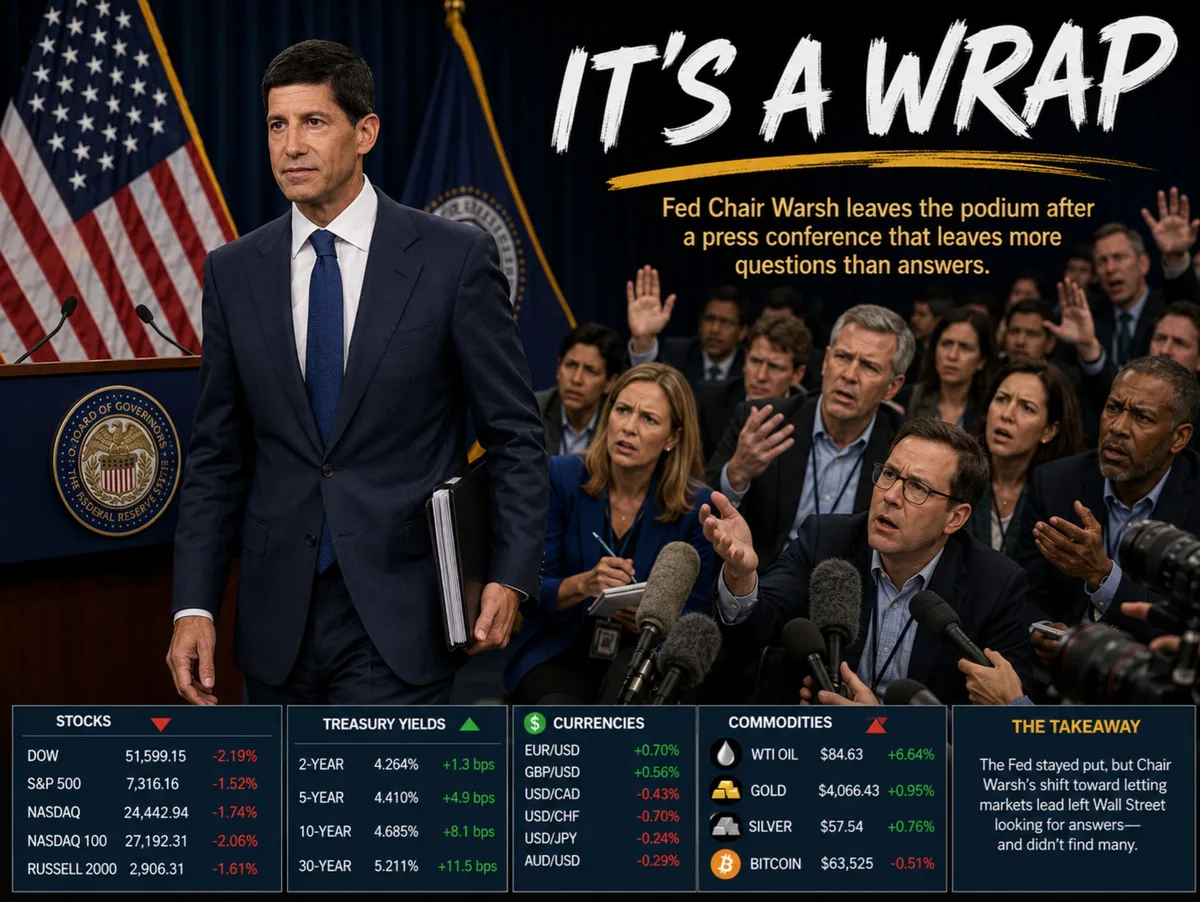
The Federal Reserve held interest rates steady Wednesday, but it was Chair Kevin Warsh's deliberate abandonment of forward guidance that rattled investors and sent markets broadly lower. In his press conference, Warsh made clear that economic data and bond-market signals — not Fed signaling — will now dictate the direction of monetary policy, a meaningful break from the hand-holding approach that defined the central bank for years.
Treasury yields surged in response, particularly at the long end of the curve. The 30-year yield jumped nearly 12 basis points to 5.211%, and the 10-year climbed 8.1 basis points to 4.685%, reflecting investors scrambling to reprice risk without a Fed roadmap. The muted 1.3-basis-point rise in the 2-year yield underscored deep uncertainty about when the next policy move might actually arrive.
Read more Procter & Gamble Beats EPS but Misses Revenue Estimates →
Equities took a broad hit, finishing near session lows as rising long-term yields compressed valuations. The Dow dropped 2.19%, the Nasdaq 100 fell 2.06%, the S&P 500 lost 1.52%, and the Russell 2000 declined 1.61%. Technology and AI-adjacent names — already stretched after recent rallies — faced compounding pressure as higher borrowing costs dimmed their growth-multiple appeal.
The dollar weakened against most major currencies despite the yield spike, with the euro gaining 0.70% and the British pound up 0.56%, a divergence analysts may attribute to the broader risk-off selling in U.S. assets. Crude oil was the standout winner, surging $5.30 to $84.63 on geopolitical tensions, while gold advanced nearly 1% as investors sought safe-haven cover even amid rising yields. Bitcoin slipped 0.5%.
The day's core message was less about an on-hold rate decision and more about a Fed signaling it is stepping back from market management. If Warsh holds this course, traders should brace for elevated volatility driven by data prints and bond-market moves rather than central-bank cues. Continue reading at Forexlive.